Products & Services
Support
Company
Contact Us

The animator's approach to a golf swing robot
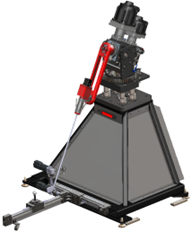
The ADC SwingFore is a servo-controlled, multi-axis swing robot capable of swing speeds up to 140 MPH with a standard driver. Unlike conventional point-to-point robots, SwingFore is built as an animation device — operators define the key positions of the swing on a timeline, and the robot plays back the motion exactly as designed. The result is a system that replicates any swing style, from amateur to tour professional, with the repeatability needed for R&D, ASTM-style certification, and production-rate durability testing.
The SwingFore is engineered for the realities of modern equipment R&D and quality control. With a club speed range from a slow practice tempo up to 140 MPH at the head of a 45.5" driver, a single SwingFore replaces a roster of test players — driver, fairway, hybrid, iron, wedge — and reproduces the same swing every time. Operators can dial in straight shots, draws, fades, pulls, hooks, slices, and even shanks for failure-mode testing.
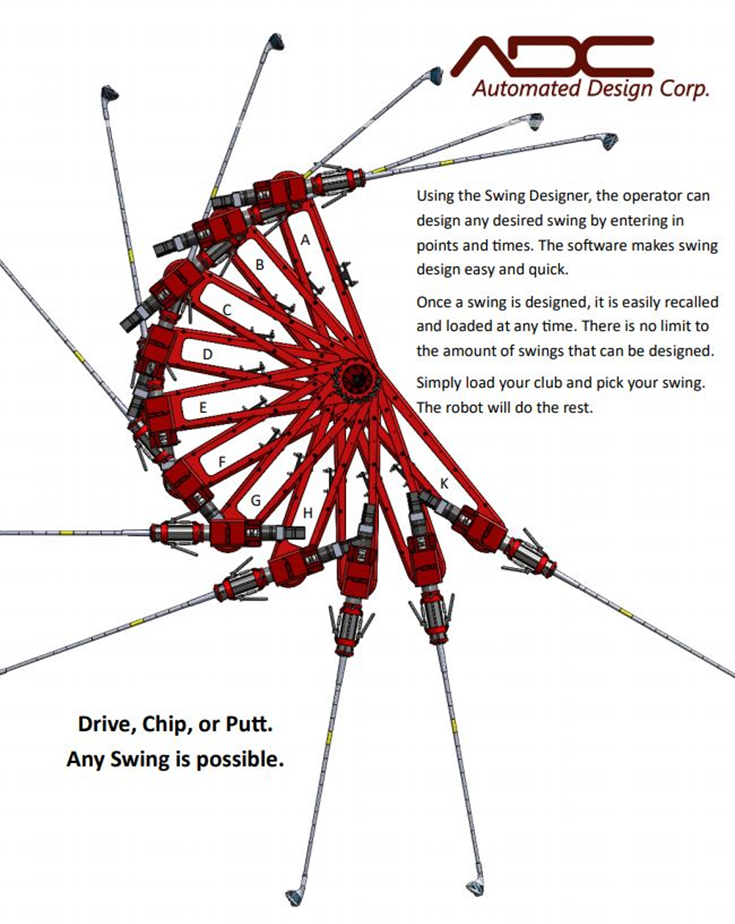
Traditional industrial robots think in terms of moves, speeds, and distances. The SwingFore doesn't. At its core, the SwingFore is an animation device. The operator describes the swing the same way an animator describes a character's motion — by setting key positions in time. The SwingFore's proprietary spline engine fills in the frames in between using a constrained cubic-spline algorithm that minimizes "jerk" and reproduces the natural, fluid acceleration of a human swing. The operator is the coach, the robot is the athlete, and the motion engine is the choreographer.
This animation-first approach makes the SwingFore uniquely flexible. There is no fixed library of "swing types" to choose from; any swing the user can describe in keyframes — three points or three hundred — can be played back at any speed. Every swing is saved as a portable JSON file, ready to be shared between systems, archived, or replayed years later for back-to-back equipment comparisons.
SwingFore was built from the ground up to allow for production-rate use. Loop Mode plays back only the downswing and follow-through, looping over to the next swing without unwinding — maximizing throughput for high-cycle durability testing. When combined with the optional BALL-E automated tee loader and tee table axes, the SwingFore becomes a fully unattended test cell. Optionally, with the proper safety systems installed, the system can be configured to run continuously with no operator intervention.
Every SwingFore is built on industrial automation hardware trusted by Fortune 500 manufacturers, and features the ADC autocore platform, which runs on laboratory automation systems worldwide to provide advanced capabilities beyond legacy automation systems, enhanced support and serviceability, and complete reliability. The EtherCAT fieldbus provides sub-millisecond communication between controller and drives, yielding perfect repeatability from the robot.
SwingFore's user interface is served as a web application directly from the embedded controller. Any modern browser on any computer on the network is a workstation. No software to install, no licenses to manage, no version-control headaches across multiple operator PCs.
The interface includes a complete sequence editor with three views — Arm, Secondary Axes (wrist, grip, hip), and Review — plus a built-in scope that captures the actual motion of every axis at 1 kHz during the downswing and follow-through. Edit a profile, run it, review the trace, and refine — without ever leaving the browser.
SwingFore is a true multi-axis platform. The standard configuration includes:
Optional axes for advanced testing:
The SwingFore platform is built around the swing, not a specific sport. The same hardware and software power ADC's baseball/softball, pickleball, lacrosse, and other striking-implement test systems. A SwingFore configured today is a platform you can re-purpose tomorrow.